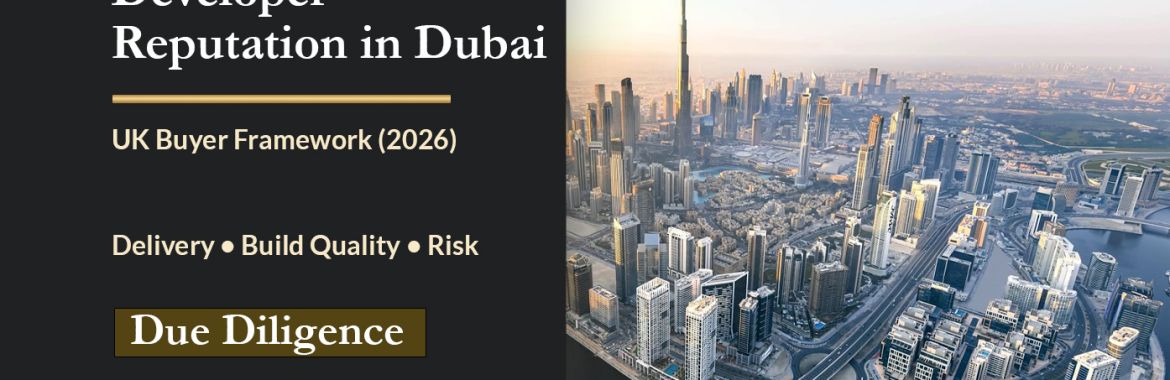
Developer Reputation in Dubai (UK Buyer Framework 2026): How to Assess Delivery History, Build Quality & Risk Without Guesswork
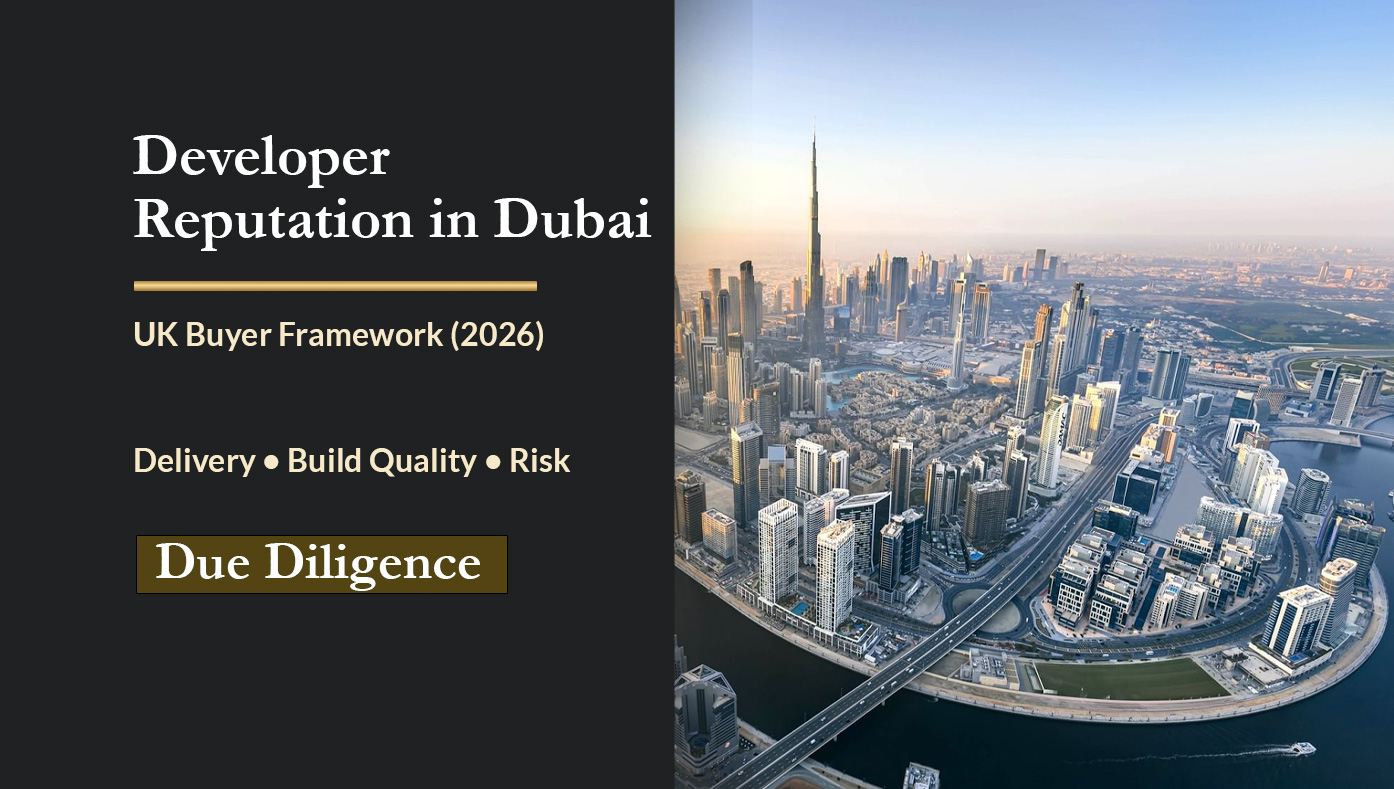
The single most underestimated factor in Dubai property investing — and the reason two “similar” off-plan deals can produce completely different outcomes for UK buyers.
If you’re researching investing in Dubai from the UK, considering off-plan opportunities, or comparing new launches while remaining based in London or elsewhere in Britain, this guide focuses on one core truth: developer reputation is not branding — it is risk management.
UK investors don’t lose money in Dubai because the market “fails.” They lose money when they back the wrong execution partner. In a city that builds fast and launches often, understanding who delivers well, who delivers late, and who quietly cuts corners matters more than glossy renders or sales presentations.
This framework is designed to help UK and global investors assess developer credibility with clarity — even when buying remotely.
For wider context on the UK-to-Dubai buying process, begin with invest in Dubai from UK and buy property in Dubai from London.
1) Why Developer Reputation Carries More Weight in Dubai Than Many UK Buyers Expect
In the UK, development risk is often absorbed into slow planning cycles and conservative delivery timelines. In Dubai, development is faster, more competitive, and more varied in execution quality.
That speed creates opportunity — but it also creates spread.
Two developers can launch projects in the same area, at similar prices, with similar layouts — yet:
- One hands over on time with clean finishes and stable service charges
- The other delays, delivers inconsistently, and burdens owners with long-term costs
For UK buyers, especially those investing remotely, developer reputation becomes your first layer of due diligence — long before you look at ROI projections.
2) Reputation Is Not Popularity: What UK Investors Should Actually Measure
Many overseas buyers confuse marketing visibility with credibility.
A serious developer assessment looks beyond:
- Billboards and launch events
- Celebrity endorsements
- Short-term hype around a single project
Instead, UK investors should focus on:
- Delivery history (did past projects complete on time?)
- Finish consistency (are completed buildings holding quality?)
- Post-handover performance (maintenance, management, service charges)
- Resale behaviour (do units transact easily after completion?)
Reputation is earned over multiple cycles — not announced at launch.
3) On-Time Delivery vs “Technically Completed”: A Critical Distinction
One of the most common UK buyer misunderstandings is the meaning of “completion.”
Some developers:
- Deliver on or near schedule
- Complete infrastructure and amenities promptly
- Provide smooth snagging and handover processes
Others:
- Delay handover repeatedly
- Deliver units before shared facilities are usable
- Create friction during snagging and defect resolution
This is why developer reputation ties directly into Title Deed vs Oqood in Dubai — because resale readiness depends on how and when ownership is finalised.
4) Build Quality Is a Long-Term Cost Issue, Not a Cosmetic One
Poor build quality rarely shows itself immediately. It emerges over time — through maintenance issues, tenant complaints, and rising service charges.
UK investors should understand:
- Good developers optimise layouts for long-term living
- Weak developers prioritise speed and appearance over durability
Build quality directly affects:
- Tenant retention
- Maintenance frequency
- Service charge inflation
- Resale buyer confidence
This is why developer reputation cannot be separated from Dubai property service charges explained for UK investors. Weak construction almost always becomes a financial issue later.
5) Escrow Accounts & Payment Milestones: What Reputation Reveals
Dubai’s escrow system protects buyers — but how developers use it varies.
Strong developers:
- Follow realistic construction-linked payment plans
- Maintain transparency around progress
- Avoid aggressive early payment pressure
Weaker developers often:
- Front-load payment schedules
- Over-promise timelines
- Rely heavily on continued sales to fund completion
UK investors should never assess payment plans in isolation. They must be judged against a developer’s historic behaviour.
6) Developer Reputation and Exit Strategy: The Hidden Link
Even if you never plan to sell, your future buyer will.
Resale buyers routinely ask:
- Who built this building?
- How is it maintained?
- What’s the reputation of the developer?
Projects by trusted developers typically:
- Resell faster
- Attract broader buyer pools
- Remain mortgage-eligible longer
This ties directly into exit strategy planning for UK investors, because reputation follows the asset long after handover.
7) Area Strength Cannot Fully Offset Weak Development
A common UK buyer assumption is: “The area will carry the investment.”
In reality:
- Strong areas contain both strong and weak buildings
- Tenants and buyers compare buildings, not just postcodes
This is why experienced investors analyse developers alongside area fundamentals such as:
- Dubai Marina investment for UK buyers
- Business Bay UK investment guide
- Dubai Hills Estate guide for UK investors
Area demand attracts interest. Developer credibility converts interest into value.
8) How UK Investors Can Assess Developer Reputation Remotely
You do not need to fly to Dubai to evaluate a developer properly — but you do need a framework.
A practical UK checklist includes:
- Reviewing completed projects, not brochures
- Comparing promised vs delivered amenities
- Checking service charge history post-handover
- Analysing resale activity in completed buildings
- Understanding how snagging and defects were handled
This aligns closely with remote buying due diligence for UK investors, where developer quality sits at the core.
9) Branded, Boutique & Mega Developers: What UK Buyers Should Know
Not all reputable developers are the same.
- Mega developers often offer scale, infrastructure integration, and resale depth
- Boutique developers can offer design-led appeal but require deeper due diligence
- Branded residences rely heavily on long-term brand maintenance agreements
UK investors should assess whether a developer’s model aligns with their strategy — income, growth, lifestyle, or resale focus.
Final Verdict: Developer Reputation Is the Foundation, Not a Bonus
Dubai remains a world-class property market — but it is not a uniform one.
For UK and global investors, developer reputation is the invisible structure beneath every return projection. It shapes delivery timelines, running costs, tenant experience, resale liquidity, and long-term value.
The investors who succeed consistently are not those who chase the newest launch — they are those who align capital with developers who have proven, repeatable execution.
If you treat developer assessment as a strategic filter rather than a background check, Dubai becomes far more predictable, defensible, and rewarding as an investment market.