Dubai Real Estate During the 2026 GCC Conflict: What UK Investors Should Actually Watch Before They Panic

When fear gets louder, serious investors usually slow down, think better, and buy smarter.
There is a lot of noise around the Dubai real estate market right now. Social media is full of dramatic opinions. Some people are saying the market will crash. Others are pretending nothing has changed. Neither side is helping UK investors make a smart decision.
The truth is more balanced, and far more useful. Yes, the current regional conflict has created concern. Yes, headlines can affect sentiment, travel plans, and short-term buyer confidence. But that still does not automatically mean the long-term case for investing in Dubai property from the UK has disappeared. In fact, this is exactly the kind of moment when serious buyers need less panic, more clarity, and much stronger decision-making.
If you are based in London, Manchester, Birmingham, Glasgow, or anywhere else in the UK and you are thinking about buying property in Dubai, the real question is not whether fear exists. It clearly does. The real question is whether fear is temporary noise or a sign that the whole investment case has changed. For disciplined buyers, that is the difference between making a costly emotional mistake and making a confident move at the right time.
This is where many investors get it wrong. They react to headlines before they study the structure of the market. They confuse temporary uncertainty with long-term weakness. They assume that a difficult geopolitical moment wipes out everything that made Dubai property investment attractive in the first place. In reality, smart money does the opposite. It looks past the noise, studies the numbers, checks the fundamentals, and then decides where risk is real, where opportunity still exists, and which assets deserve attention.
What is actually happening in Dubai real estate right now?
The current conflict has absolutely made some buyers nervous, and that is understandable. Markets do not move only on fundamentals. They also move on confidence. When confidence is shaken, people pause. Some delay travel. Some postpone purchases. Some become more selective. Some start looking only at completed homes instead of future launches. That kind of shift is normal in periods of uncertainty.
But the important point is this: a market becoming more selective is not the same thing as a market becoming broken. That distinction matters. The Dubai real estate market entered 2026 after a period of major growth, strong transaction activity, solid rental demand, and deep international interest. So while the conflict has introduced caution, it has not suddenly erased Dubai’s position as one of the world’s most watched real estate destinations.
That is why blanket statements like “Dubai is finished” or “now is the perfect time to buy anything” are both unhelpful. The better answer is more mature. Some parts of the market may feel pressure. Some buyers may step back temporarily. Some off-plan demand may become more careful. At the same time, well-located, well-priced, well-managed assets can still attract serious attention because real demand drivers do not disappear overnight.
Why panic posts are giving people the wrong picture
Most fear-driven content online is built around the same weakness: it focuses only on the headline and ignores the full market structure behind it. That is dangerous for UK property investors in Dubai because it turns a serious investment decision into an emotional reaction.
Dubai was never attractive because it was a fantasy market where nothing ever changes. It became attractive because it offers a combination many international investors still struggle to find elsewhere: global connectivity, tax efficiency, strong international visibility, a wide range of communities, comparatively strong rental potential, residency-linked advantages for some buyers, and a property ecosystem that is much easier to access than many first-time overseas investors expect.
Even in a tense period, those advantages still matter. People still need homes. Tenants still move. Companies still operate. Families still relocate. Global capital still searches for cities that are easier to enter, easier to manage, and easier to scale in than traditional mature markets. That is one of the reasons many British buyers continue to study Dubai even when the news cycle becomes uncomfortable.
So no, this is not a moment for blind optimism. But it is also not a moment to abandon logic. It is a moment to become more selective about where to invest in Dubai, what kind of property to buy, and which real estate partner to trust.
What strong investors should focus on instead of fear
If you want to protect your capital and still move toward a stronger long-term future, the smartest approach is not panic. It is precision. That means focusing on the areas of the market that remain understandable, measurable, and defendable even during uncertainty.
The first thing to focus on is location quality. Not every community performs the same way in a nervous market. Locations with stronger tenant depth, better daily livability, easier resale appeal, and practical connectivity usually hold attention better than hype-driven launches that depend only on excitement. This is why demand-led areas remain so important for Dubai investment property.
The second thing to focus on is developer strength. In good times, average developers can still look attractive. In uncertain times, quality becomes far more visible. Delivery history, build quality, escrow discipline, community planning, finishing standards, and after-sales reliability all start to matter more. That is exactly why buyers should take time to review how developer reputation affects investment risk in Dubai before making any decision.
The third thing to focus on is real income logic. A property should not only look beautiful in marketing brochures. It should also make sense when it comes to rentability, service charges, operational costs, tenant appeal, and long-term hold strategy. Buyers who understand the full cost of buying property in Dubai from the UK, how overseas property management works, and how Dubai property ROI really works are usually far better protected than buyers who only chase a launch discount.
Why Dubai property still deserves serious attention from UK investors
For British buyers, the appeal of Dubai has never been based on one single factor. It is the combination that makes the city powerful. You have a market that is internationally recognised, globally marketed, tax-efficient compared to many traditional jurisdictions, and relatively straightforward for overseas buyers to access. You also have a city that continues to attract entrepreneurs, professionals, families, remote operators, and global wealth from multiple regions.
That combination still matters today. In fact, when uncertainty rises, global investors often become even more focused on places that combine visibility, liquidity potential, and lifestyle strength. That does not mean every building or every project is a great purchase. It means the city itself still belongs in the conversation.
There is also a more practical truth many people ignore. A lot of UK investors are not only buying for quick flips. Many are buying for long-term income, currency diversification, succession planning, part-time use, or future relocation flexibility. For those kinds of buyers, short-term market noise is important to understand, but it is not the only thing that matters.
If your objective is to build a more secure international property position over the next five to ten years, you should not let one difficult news cycle make the whole decision for you. You should let due diligence make the decision.
What kind of Dubai investment strategy makes the most sense now?
Right now, the best strategy is usually not the loudest one. It is the clearest one.
For many buyers, that means giving more attention to ready property in Dubai, proven resale stock, and communities where tenant demand is already visible. In a more cautious market, completed assets with real-world comparables can feel more comfortable than buying purely from a future promise. That does not mean off-plan property in Dubai is automatically the wrong choice. It simply means off-plan has to be filtered more carefully through developer credibility, project positioning, payment structure, location strength, and likely end-user demand.
That is also why this moment naturally connects with broader strategic reading such as how to build a Dubai property portfolio from the UK, how to compare buildings properly before you buy, and how market cycles and exit planning affect long-term returns.
For first-time overseas buyers, this is also a good moment to simplify. Instead of trying to chase every trending launch, choose one asset class, one budget range, one location style, and one realistic outcome. A clean strategy often outperforms an emotional one.
Which areas still make sense for UK buyers investing in Dubai?
In a market where confidence matters, communities with established demand become even more important. That is why many buyers continue to watch locations that offer a strong mix of lifestyle appeal, tenant interest, and relative accessibility.
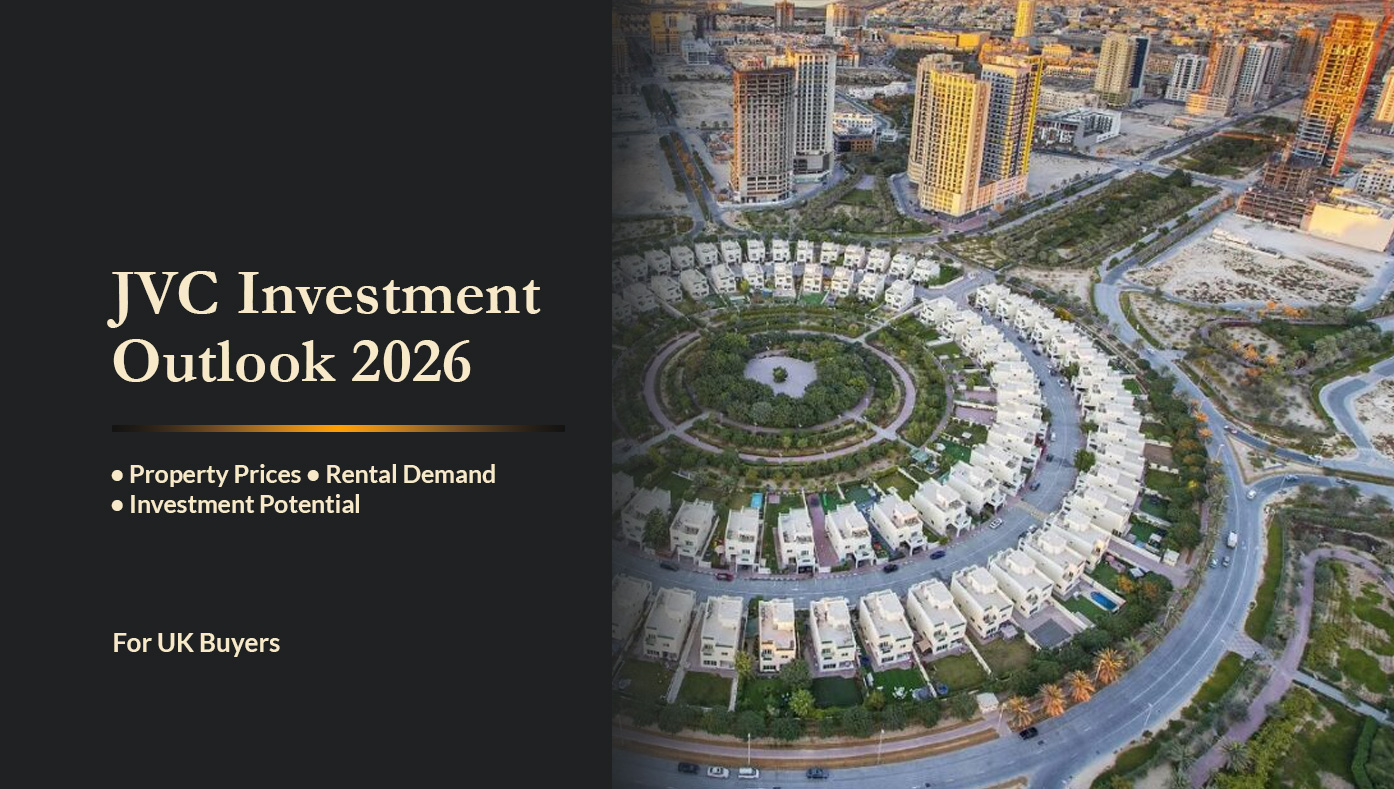
For example, communities such as JVC, Arjan, Business Bay, Dubai South, Emaar South, and selected parts of Dubai Marina remain relevant because they are not just brand names. They each fit a different investor profile, from rental-led apartments to growth-oriented communities and established urban districts.
The point is not to declare one area the winner for everyone. The point is to match the asset to the investor. A buyer seeking stronger rental movement may choose very differently from a buyer focused on long-term capital preservation, family use, or future relocation. That is exactly why thoughtful advisory support matters so much in uncertain periods.
What UK investors should avoid doing right now
This is not the moment to buy because a salesman says prices will “double soon.” It is not the moment to ignore paperwork. It is not the moment to send funds before checking the legal and transactional structure properly. It is not the moment to choose a project simply because the payment plan sounds easy.
It is also not the moment to rely on WhatsApp forwards, fear-based commentary, or half-informed social media threads to shape a six-figure or seven-figure decision. Overseas property decisions need calm research, not adrenaline.
Before moving forward, buyers should be clear on the legal side, the transfer side, and the documentation side. That includes understanding how to buy property in Dubai from London, how to transfer money safely from the UK, which property documents should be reviewed before payment, and in some cases whether buying through a UK limited company makes sense.
That kind of preparation does not slow a buyer down in the wrong way. It protects them in the right way.
Why this moment can still be an opportunity
Some of the best real estate decisions are made when the market becomes quieter, not louder. When hype cools, buyers often ask better questions. Negotiations can become more realistic. Sellers become easier to read. Investors stop chasing headlines and start studying value.
That does not mean every uncertain period becomes a buying window. But it does mean disciplined buyers may find better entry points, better deal structures, and better conversations than they would during a peak wave of unchecked excitement.
For long-term Dubai property investors, the right way to think about this period is not “ignore the conflict” and not “run away from Dubai.” The right mindset is this: understand the current risk, respect the mood of the market, stay selective, and use the moment to position yourself more intelligently than the crowd.
The real takeaway for Dubai real estate investment from the UK
Dubai real estate is not a panic market; it is a decision market.
Yes, the current conflict has raised valid questions. Yes, buyers should pay attention. And yes, short-term sentiment can soften. However, the long-term appeal of Dubai property investment was not built on a single news cycle—and it should not be judged by a week of fear-driven commentary.
For UK investors, the smart path remains the same: choose the right location, the right property type, the right strategy, and the right partner. When you do that, fear stops being the headline and starts becoming part of the analysis.
If your goal is to build income, diversify internationally, and protect capital within a globally recognized market, Dubai property still deserves serious consideration—not with blind emotion or negativity, but with discipline, context, and professional guidance.
In uncertain markets, people don’t just need listings; they need judgment. For UK buyers, that judgment is what turns uncertainty into long-term opportunity.
Take the Next Step
If you are based in the UK and want clear, honest guidance on Dubai real estate investment, speak with Aeon & Trisl. We provide a smarter property strategy built on prime locations, real data, careful due diligence, and long-term confidence.
Editor’s Note: Our insights are informed by current travel guidance, live market reporting, and official Dubai property data. We cross-reference the latest UK Government travel advice for the UAE with Reuters analysis, Dubai Land Department updates, and the Knight Frank 2026 Residential Review to ensure you have the most reliable investment context.