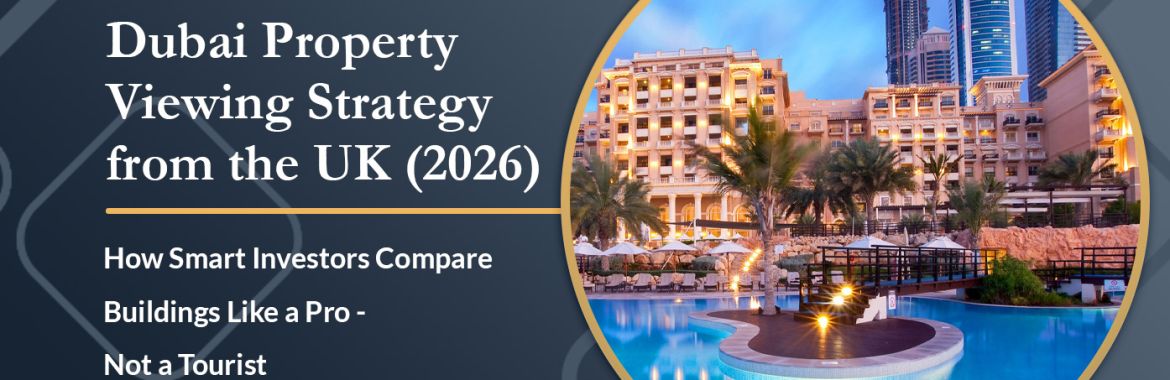
Dubai Property Viewing Strategy from the UK (2026): How Smart Investors Compare Buildings Like a Pro — Not a Tourist

The biggest mistake overseas buyers make isn’t choosing the wrong area. It’s choosing the wrong building inside the right area.
For UK investors buying Dubai property remotely, “viewing” is not about glossy videos, drone shots, or sales brochures. It’s about building intelligence — understanding how one tower, block, or villa cluster performs compared to another just metres away.
This guide is designed for serious UK buyers who want to compare Dubai properties properly without flying over, avoid emotional decisions, and build a shortlist that stands up to rental reality, resale pressure, and long-term ownership — all while staying based in Britain.
If you’re still early in your journey, anchor this with how to buy property in Dubai from the UK and Dubai property investment guide for UK buyers.
1) Why “Area-First” Thinking Fails UK Investors
Most overseas buyers start with area headlines:
Dubai Marina. Downtown Dubai. Business Bay. JVC.
Areas matter — but they don’t perform equally at building level.
In Dubai, two neighbouring buildings can deliver:
- very different rental demand
- very different service charges
- very different resale liquidity
UK investors who rely only on area reputation often end up with assets that look good on paper but underperform in practice. That’s why professional buyers reverse the process: building first, postcode second.
2) The UK Investor’s Building Scorecard (What Actually Matters)
When comparing properties remotely, strip emotion out and score each building across fixed criteria.
Core performance factors:
- Service charge efficiency — reviewed alongside Dubai property service charges
- Tenant demand — who actually rents here?
- Management quality — response time, cleanliness, retention
- Unit layouts — rentable, not just pretty
- Resale depth — how fast comparable units move
Buildings that score consistently well outperform “iconic” towers with weak fundamentals.
3) Floor Plans Beat Floor Level (Most of the Time)
UK buyers often fixate on:
high floors, corner units, dramatic views.
In reality, floor plan efficiency usually matters more than height.
Strong layouts:
- rent faster
- furnish more easily
- appeal to wider tenant pools
This is especially true in rental-led areas like JVC and Business Bay, where tenants prioritise liveability over prestige.
4) Views, Noise & Orientation: The Details That Kill Returns
From the UK, these factors are easy to miss — and expensive to fix.
Always verify:
- road proximity (traffic noise impacts rent)
- future construction (temporary views don’t last)
- sun orientation (heat exposure affects tenant comfort)
- balcony usability (many are decorative, not functional)
Professional remote viewing includes video walkthroughs at different times of day — not just staged daylight footage.
5) Comparing Ready vs Off-Plan Buildings Remotely
Remote evaluation differs depending on asset type.
Ready properties
- verify actual condition, not photos
- check live rental comparables
- review management track record
Off-plan properties
- assess developer delivery history
- review escrow protection
- compare handover promises to past performance
This aligns closely with new-build vs resale buildings in Dubai and developer reputation frameworks.
6) Rental Reality Check: Ignore “Expected Yield” Claims
UK investors should never rely on advertised yields.
Instead, demand:
- real rent achieved in the same building
- average vacancy periods
- net figures after service charges and management
Tie this back to invest in Dubai rental market from UK to anchor expectations in reality.
7) Short-Term vs Long-Term Suitability (Decide Before Viewing)
A building that works for long-term tenants may be terrible for short-term stays — and vice versa.
Short-term suitability depends on:
- licensing acceptance
- lift access and reception layout
- guest flow management
Before viewing with a short-term lens, understand Dubai short-term rental rules to avoid mismatches.
8) The “Same Area, Different Outcome” Effect
In locations like Dubai Marina and Downtown Dubai, outcomes diverge sharply by building.
Some towers:
- rent immediately
- resell quickly
- retain value through cycles
Others struggle — despite identical postcodes.
Remote viewing strategy is how UK investors separate these outcomes before committing capital.
9) Who Should Actually “View” on Your Behalf?
The person representing you matters as much as the property.
You want someone who:
- compares buildings, not just units
- flags negatives early
- understands UK investor priorities
- does not push urgency
This is where working with a London-based Dubai real estate company becomes an advantage — UK expectations, Dubai execution.
10) Viewing Is a Filtering Tool, Not a Selling Moment
Professional investors use viewing to:
- eliminate weak options fast
- validate assumptions
- compare buildings objectively
If everything “looks great”, the process isn’t rigorous enough.
Final Verdict: Buildings Make Money, Not Brochures
For UK investors buying Dubai property remotely, viewing strategy is not about excitement — it’s about elimination.
The strongest portfolios are built by buyers who:
- compare buildings clinically
- model net outcomes
- ignore hype
- prioritise resale and rentability
Dubai rewards disciplined comparison. Especially when you’re buying from the UK.