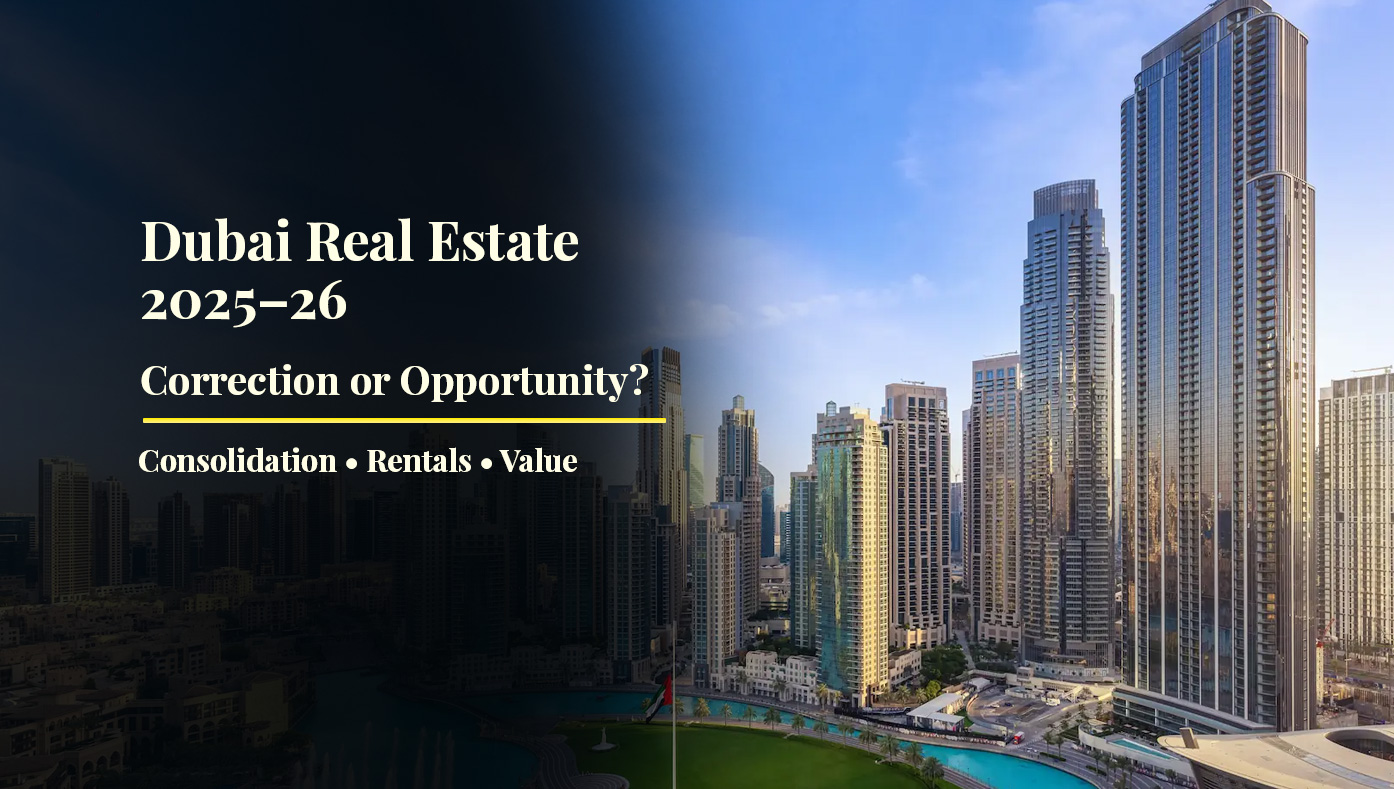
Dubai Real Estate 2025–26: Correction, Consolidation, or Opportunity? What Smart Investors Are Actually Watching
Every time Dubai’s property market enters a new phase, the same word starts circulating again: correction.
For seasoned investors, that word is rarely alarming. For newer or overseas buyers — particularly those observing the market from the UK — it can feel unsettling, even confusing. Headlines amplify uncertainty, social media magnifies extremes, and casual commentary often lacks context.
The reality is far more grounded.
Dubai in 2025–26 is not “breaking” — it’s sorting itself out.
And historically, markets that go through periods of consolidation and self-correction tend to reward investors who understand where to look, what to ignore, and why disciplined analysis consistently outperforms prediction.
This article is not about fear or hype. It’s about how experienced investors — including many UK-based buyers — are reading the Dubai property market quietly, rationally, and profitably.
Why the “Correction” Narrative Keeps Getting Misused
Dubai’s real estate market does not behave like slower, supply-constrained Western cities.
It is:
- globally capitalised
- highly liquid
- fast to deliver new supply
- driven by international demand rather than local wage cycles
Because of this speed, normal market recalibration is often mislabelled as distress.
What many commentators are calling a “correction” in 2025–26 is, in practice:
- price stabilisation following rapid post-2021 growth
- absorption of heavy off-plan handovers
- the cooling of speculative flipping behaviour
- a return to rental-led valuation logic
None of these indicate systemic weakness. They indicate a maturing investment market.
Every developed real estate market goes through these phases. Dubai simply does it faster — and more visibly.
Correction vs Consolidation: A Critical Distinction
A correction implies broad value destruction. Consolidation implies digestion.
What we are seeing in Dubai is consolidation:
- prices moving sideways in certain segments
- buyers becoming more selective
- negotiation power returning
- asset quality starting to matter more than launch timing
For investors, consolidation is not a threat — it is a filter.
It removes momentum-driven buyers and rewards those who focus on fundamentals.
What Serious Investors Are Actually Tracking (Not Headlines)
Experienced investors are not watching daily price charts or viral predictions. They are watching behaviour.
Specifically:
- Rental absorption rather than optimistic asking prices
- Tenant demand rather than launch-day sell-outs
- Building-level performance rather than district averages
- Resale liquidity rather than projected appreciation curves
A building that rents consistently, maintains occupancy, and resells without discounting during mixed market conditions is a far stronger signal than any macro headline.
This is precisely where overseas investors — particularly UK buyers accustomed to yield modelling and long-term holding — often outperform speculative entrants.
Where Market Pressure Is Appearing (And Why That’s Normal)
Pressure is not evenly distributed across Dubai. It is concentrated.
Most friction is appearing in:
- projects dominated by short-term speculative demand
- undifferentiated towers launched during peak sentiment
- buildings with high service charges and weak management
- units purchased purely on brochure-level promises
This is not a city-wide issue.
It is an asset-selection issue.
Markets do not punish cities.
They punish poorly chosen assets within them.
Why UK Investors Are Structurally Better Positioned
UK investors, as a group, tend to approach Dubai differently from fast-cycle traders.
In practice, they are more likely to:
- focus on income rather than quick resale
- model net yield, not headline returns
- compare buildings, not just locations
- buy with longer holding horizons
This discipline becomes an advantage during periods of recalibration, when emotion exits the market and pricing becomes rational again.
For buyers using a structured framework, Dubai remains one of the most transparent and regulation-backed international property markets available.
Useful foundation reading: Dubai property investment guide for UK buyers 2026
Opportunity Doesn’t Come from Timing — It Comes from Filtering
The most consistent investors are not trying to “call the bottom”.
Instead, they:
- filter aggressively
- negotiate patiently
- prioritise buildings with proven demand
- buy assets that perform even if prices move sideways
This is where quiet opportunity lives.
Periods like 2025–26 tend to separate:
- investors from speculators
- planners from gamblers
- portfolios from one-off purchases
When sentiment cools, fundamentals re-price faster than headlines.
The Biggest Mistake Investors Make During Market Noise
The most damaging response is not action — it’s paralysis.
Hesitation without analysis often leads to:
- missed negotiation windows
- delayed portfolio compounding
- rushed decisions when sentiment reverses
Markets rarely feel comfortable at moments of opportunity.
They feel uncertain — which is precisely why pricing flexibility appears.
Dubai’s Long-Term Drivers Have Not Changed
Short-term noise does not override structural reality.
Dubai continues to benefit from:
- sustained population inflows
- global business relocation
- ongoing infrastructure investment
- international lifestyle demand
- investor-friendly ownership and tax frameworks
These drivers do not move quarter to quarter.
They compound over years.
Final Perspective: Calm Markets Reward Calm Investors
Dubai’s 2025–26 phase is not about panic or prediction. It is about discipline.
Investors who understand:
- what they are buying
- why they are buying it
- who will rent it
- who will buy it next
tend to perform well regardless of short-term sentiment.
The real risk is not market movement.
The real risk is buying without a framework.
For investors — especially those operating from the UK — Dubai remains a market where clarity beats courage, structure beats speed, and strategy beats speculation.