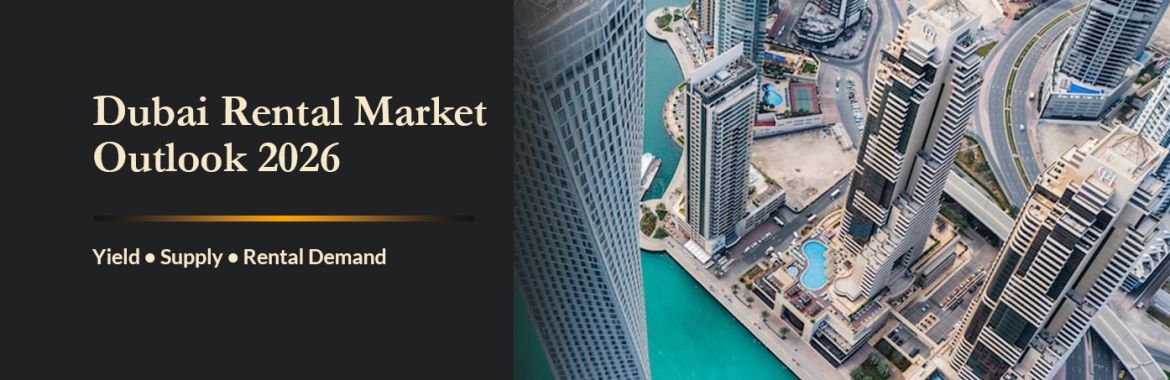
Dubai Rental Market Outlook 2026 for London, UK: What Serious Investors Should Expect from Yield, Supply, and Rental Demand
📈 Is Dubai still one of the strongest rental markets for UK buyers, or is 2026 the year investors need to stop relying on old assumptions?
For many investors in London and across the UK, Dubai rental market outlook 2026 is no longer a casual search.
It is a decision-stage search.
People are not just asking whether Dubai still looks attractive. They are asking a much sharper question now: is this still a genuinely strong rental market for overseas buyers, or are yields starting to compress as more supply enters and pricing becomes more selective?
That is the right question to ask.
Because the story in 2026 is no longer about easy momentum. It is about discipline. It is about understanding where rental demand still feels durable, where pricing has run too far ahead of income, and how London-based investors should think about net returns rather than headline excitement.
The good news is that Dubai’s rental market has not lost its relevance. Far from it. But it has become more mature, more layered, and much less forgiving of lazy buying.
This guide breaks down what that really means for British investors, landlords, and overseas buyers looking at Dubai rental property from London and the wider UK.
What actually changed in the Dubai rental market going into 2026?
The easiest mistake in property content is to speak as if the market either boomed or cooled, and leave it there.
Real life is more nuanced than that.
Dubai Land Department said the emirate’s rental sector stayed strong throughout 2025, with registered tenancy contracts up 6% year on year to 1.38 million and the total contract value up 17% to AED 126.4 billion. New tenancy contracts rose more than 10%, while renewed contracts increased 3%, which points to both new demand and ongoing tenant retention rather than a market that has suddenly stalled.
That matters because it tells us something important about the starting point for 2026. This is not a market coming off a cliff. It is a market moving from rapid growth into a more mature phase where building quality, area selection, tenant depth, and realistic pricing matter more than they did at the height of the cycle.
So, is yield stability holding up, or is yield compression starting to win?
The honest answer is: both are happening, depending on what you buy and where you buy it.
That is why investors need to stop treating Dubai rental yields as one city-wide number.
In some parts of the market, especially where capital values have surged faster than rents, mild yield compression is real. In others, particularly where entry prices still feel grounded and tenant demand remains broad, income performance is holding up far better than the headlines suggest.
Cavendish Maxwell reported that rental growth in Dubai slowed to around 11% to 12% by the end of 2025, down from the 13% to 15% pace seen earlier in the year, while additional completions are expected to keep moderation going through 2026. That does not point to collapse. It points to rebalancing.
For UK investors, that is actually a useful shift.
Fast markets make people careless. Balanced markets reward better buying.
Why gross yield is no longer enough for London investors
In earlier phases of the cycle, a lot of overseas buyers were drawn in by attractive gross yield figures and left the analysis there.
That approach feels thin in 2026.
If you are buying from London, you need to think like an operator, not just a hopeful buyer. That means asking what happens after service charges, maintenance, management fees, occasional vacancy, furnishing costs where relevant, and the small but very real friction that comes with owning property from overseas.
That is why the stronger question now is not “What is the gross yield?”
It is “What is the net income quality of this asset once the real-world costs show up?”
This is exactly why it helps to pair this page with a more detailed Dubai rental market guide for UK investors, your deeper explanation of how returns really work in Dubai property, and the overlooked cost side in why service charges can change net rental income.
When buyers get disappointed in rental property, it is often not because the market failed. It is because the underwriting was too optimistic.
The Smart Rental Index changed the tone of the market too
Another reason the market feels more structured now is regulatory clarity.
Dubai Land Department launched the Smart Rental Index in January 2025, describing it as a system that uses artificial intelligence and building-level classification to support fairer, more transparent rental valuations. DLD also notes that legal rent increases under the index range from 0% when current rent is less than 10% below the average market rent, up to 20% when the gap exceeds 40%.
That matters because it pushes the rental market toward something healthier: less guesswork, more transparency, and more focus on the actual quality of the building rather than broad area assumptions alone.
For investors, it reinforces a simple truth. Two apartments in the same district can perform very differently if the buildings are managed differently, maintained differently, or classified differently.
That is one reason a building-level review often matters more than a district-level slogan. If you are still in the comparison stage, this guide on how to compare buildings in Dubai for investment becomes far more valuable than most buyers expect.
Does more supply in 2026 automatically mean weaker rental performance?
Not automatically.
And this is where the conversation usually gets oversimplified.
Yes, more stock is coming. Cavendish Maxwell projects around 110,500 residential units for delivery in 2026, although it also notes that actual completions have historically been lower, somewhere closer to 33,000 to 50,000 units. That distinction matters, because projected supply and delivered supply are not the same thing.
Even more importantly, supply does not hit the market evenly.
It lands in different areas, at different quality levels, and across very different price brackets. Some segments will feel more pressure than others. Some newer projects will compete heavily for tenants. Some established buildings with better management and better practical layouts may hold up surprisingly well.
So no, new inventory does not automatically destroy rental performance.
What it does do is punish generic assets faster. That is why 2026 looks like a year where selection quality matters more than broad bullishness.
For buyers who want exposure to newer inventory without losing sight of real-world demand, it can also be useful to compare ready-to-rent stock with the hottest Dubai property launches and judge which route actually fits your income timeline.
What is still supporting Dubai rental demand in 2026?
Even with moderation, the structural story has not disappeared.
Dubai’s rental market still benefits from the kind of support many global cities would love to have: continued population expansion, business activity, relocation demand, and a housing market that remains attractive to internationally mobile professionals and families. Official Dubai statistics continue to publish updated population estimates, while market analysts still point to population growth and talent inflows as core support for the 2026 outlook.
That does not mean every property wins.
It means the market still has real tenant depth behind it. And that is a very different thing from a market driven only by speculative noise.
Long-term rentals or short-term rentals in 2026?
This depends far less on hype than people think.
For many London-based owners, long-term rentals in Dubai remain the cleaner and more predictable model. They are easier to underwrite, easier to manage from overseas, and generally better suited to investors who want steadier income with fewer operational surprises.
Short-term rentals can still outperform in the right location and building, but only if the numbers are modelled properly and the property is managed professionally. Too many buyers compare gross nightly income to annual rent and assume the decision is obvious. It rarely is.
This is why anyone thinking seriously about rental strategy should compare short-term and long-term rentals in Dubai before assuming one route is always superior. And if you are planning to own from Britain, this guide on managing Dubai property from the UK becomes part of the decision too.
In 2026, income strategy is not just about yield. It is about workload, consistency, and how involved you want to be.
Which parts of the market still look healthiest for rental-led investors?
The strongest rental decisions usually come from matching the area to the tenant profile, not from chasing the loudest headline.
Prime districts can still work well, especially for liquidity and long-term desirability, but they may not always produce the highest percentage return once values have moved up. More value-led or mid-market communities often offer a different equation: deeper tenant pools, lower entry prices, and a more stable income story if the building and layout are right.
That is why broad area research still matters.
If your goal is rental income rather than prestige alone, start with the best areas in Dubai for buy-to-let investors from the UK. If you want a wider market view first, it also helps to compare where London and British buyers are focusing in Dubai before narrowing the search further.
The point is not to find “the best area” in the abstract.
The point is to find the right area for the kind of tenant, budget, and holding strategy you actually want.
What London, UK investors should do differently in this market
This is where the opportunity still lives.
Not in pretending the market is as easy as it was at the hottest point of the cycle, but in realising that smarter analysis now gives disciplined investors more edge than before.
In practical terms, that means slowing down and asking better questions.
Is the asset still attractive after real costs? Is the building genuinely rent-ready, not just visually attractive? Is the location supported by tenant demand that feels durable rather than fashionable? If supply rises nearby, does the property still hold up? If rents stop racing upward, does the investment still make sense?
Those questions are not negative. They are exactly how serious investors protect returns.
And for UK landlords already frustrated by thinner margins and heavier pressure at home, that is why a buy-to-let strategy beyond the UK continues to attract attention.
The real takeaway on the Dubai rental market outlook 2026
Dubai’s rental market in 2026 still deserves serious attention from London and UK investors.
But the reason is not blind momentum anymore.
It is the combination of continued tenant demand, clearer regulation, a more transparent rental framework, and a market that is becoming selective rather than weak. Some segments may feel mild yield compression. Some areas may face more competition as stock arrives. Some buyers will overpay if they chase launches without thinking about rental absorption.
But none of that changes the bigger truth.
The market still offers real opportunity for investors who understand that the easy money phase and the smart money phase are not the same thing.
In 2026, smart money is the one asking better questions.
And usually, those are the investors who end up owning the better assets.
If you want to move from generic research into real comparison, working with London real estate experts for Dubai can help make the difference between following market noise and building a rental strategy that actually holds up.
Looking at rental-led property in Dubai from London? Start by comparing areas, building quality, net return drivers, and rental strategy properly—then buy the asset that still works even when the market stops rewarding guesswork.