JVC Property Prices, Rental Demand & Investment Outlook (2026) for UK Buyers
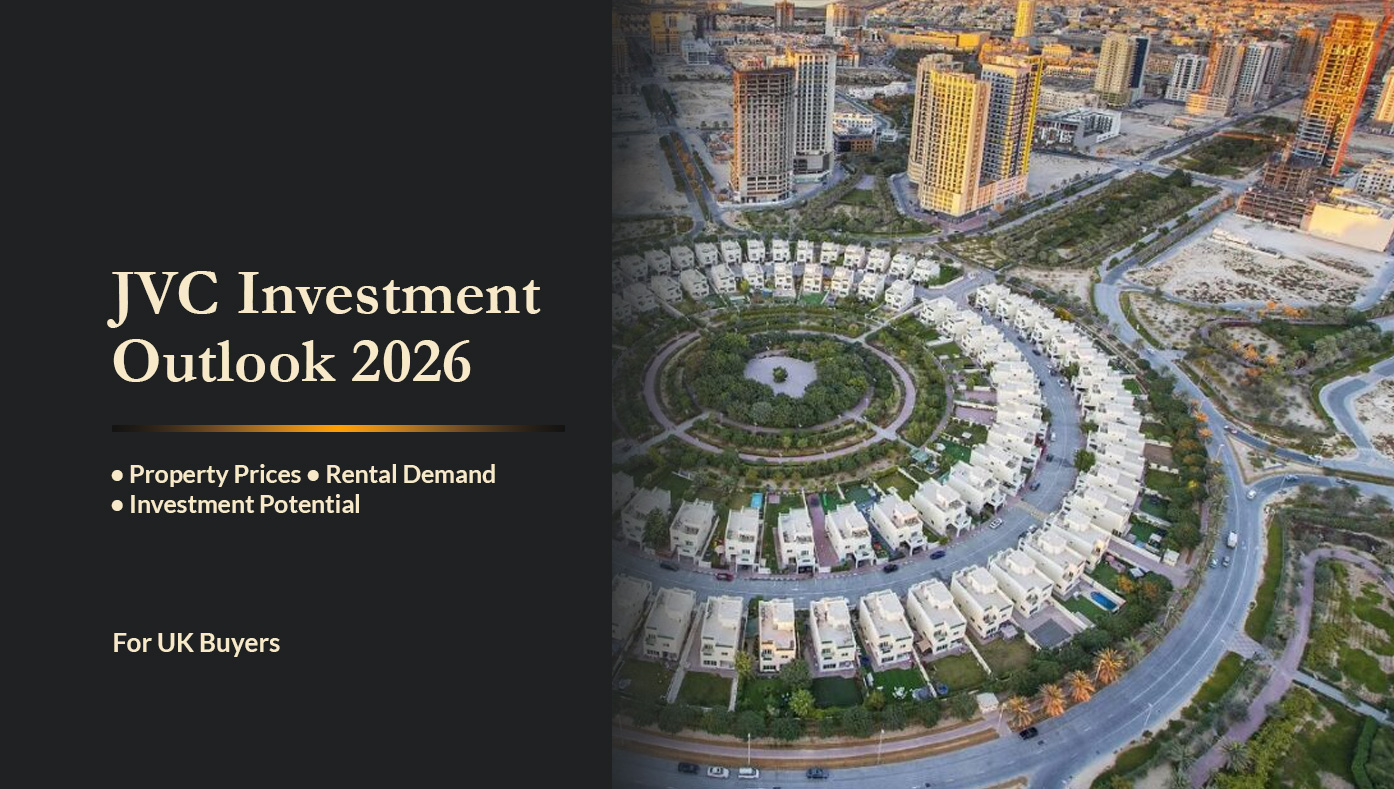
Why JVC keeps showing up on smart UK investors’ shortlists — and why that is not happening by accident.
If you speak to enough UK buyers looking at Dubai real estate, one community comes up again and again: Jumeirah Village Circle, better known as JVC. Not because it is the flashiest address in Dubai. Not because it has the glamour of Downtown or the waterfront prestige of the Marina. But because for a huge number of real-world investors, JVC property sits in that rare middle ground where entry price, rental demand, liveability, and long-term usefulness all start making sense at the same time.
That is exactly why this area matters so much in 2026. The market is no longer in a stage where buyers can throw money at any building and expect a perfect outcome. Dubai has become more sophisticated, more segmented, and more selective. In that kind of market, communities like JVC Dubai attract attention because they offer something practical: a strong mix of affordability, rental depth, everyday convenience, and broad tenant appeal.
For buyers sitting in London, Manchester, Birmingham, Glasgow, or anywhere else in Britain, that matters. Many are not just searching for a shiny overseas purchase. They want a Dubai investment property that can actually work. Something that can rent. Something that can resell. Something that does not feel painfully overexposed to pure hype. And that is where JVC property prices, JVC rental demand, and the wider JVC investment outlook deserve a much more serious look.
This guide is built to do exactly that. Not to oversell the area. Not to pretend there are no risks. But to explain why buying property in JVC from the UK continues to appeal to serious investors, what the numbers are really saying, where the opportunities still sit, and what you need to watch before you commit.
What makes JVC property different from many other Dubai communities?
JVC has earned its place in the market because it solves a problem a lot of investors face. Prime Dubai communities can be exciting, but they often require bigger capital outlay and deliver tighter yields. Ultra-affordable areas can offer tempting numbers, but sometimes the tenant profile, build quality, or resale liquidity is not as dependable as investors hope. Jumeirah Village Circle sits in between those extremes.
It appeals to professionals, couples, smaller families, first-time Dubai tenants, and investors who want unit sizes and price points that feel accessible without stepping too far away from mainstream Dubai demand. It also has one major advantage that many buyers underestimate: it is an area people can actually live in, not just speculate on. That sounds simple, but in real estate it is everything.
That is why this article should naturally connect with related reading such as why JVC keeps attracting UK-based buyers, how the JVC rental market works for overseas landlords, and what makes JVC one of Dubai’s most consistently searched investment communities.
Where do JVC property prices stand in 2026?
One of the biggest reasons UK investors keep returning to JVC Dubai is pricing. The area is no longer “cheap” in the old sense. That story is outdated. JVC has matured, and prices have moved up meaningfully over the last few years. But even after that growth, it still often feels more reachable than many of Dubai’s premium districts, especially for buyers who want apartments rather than trophy assets.
That is the sweet spot. JVC property prices have risen enough to prove demand is real, but in many cases they still leave room for income-led buying rather than purely prestige-led buying. For a lot of British investors, that is a healthier place to enter the market.
In practical terms, the area now sits in a bracket where studios, one-bedroom units, and selected two-beds can still look attractive on a yield basis, while townhouses and villas serve a different, more family-focused segment. It is not one uniform price story. It is a layered market. Some buildings are clearly better than others. Some launches are aggressively priced. Some resale units are smarter buys than new stock. That is why understanding the difference between headline area pricing and building-level pricing matters so much.
If you are comparing JVC against other communities, it is useful to also read how Business Bay compares for urban rental demand, why Arjan appeals to value-focused buyers, what Dubai South offers as a growth corridor, and how Dubai Marina performs when you move into a more premium bracket.
Is JVC still affordable for UK buyers?
Yes, but the smarter answer is this: JVC is still accessible, not automatically undervalued.
That difference matters. A lot of overseas buyers make the mistake of assuming an area is attractive simply because it is cheaper than Downtown Dubai or Dubai Marina. That is not enough. A lower price only matters if it comes with real tenant demand, acceptable build quality, manageable service charges, and reasonable future resale depth.
Jumeirah Village Circle still works because it tends to offer a wider range of buying options than many prime areas. That gives buyers more flexibility in how they enter. Someone targeting a first Dubai buy-to-let property from the UK may be comfortable with a compact studio or one-bed. Someone planning for family use, a longer hold, or a future move may look at a townhouse or larger apartment. The community supports both profiles, but the investment logic is different in each case.
This is also why a clear entry strategy matters. Before buying, British investors should understand the wider process of buying property in Dubai, how the legal buying journey works from the UK, and the rules around freehold and leasehold ownership in Dubai. Once those basics are clear, JVC becomes much easier to assess properly.
What is driving JVC rental demand in 2026?
This is the part that makes JVC especially interesting. Demand here is not built on one narrow tenant group. That matters more than people realise.
JVC rental demand is supported by professionals who want a better balance between space and cost, couples upgrading from smaller city-centre units, families who prefer a more residential feel, and tenants who want community-style living without paying prime Dubai prices. In other words, it has breadth. And breadth usually creates resilience.
That is a major reason the area keeps performing well on rental metrics. It is not dependent on one type of buyer or one type of tenant story. It serves a broad slice of Dubai’s real housing demand. In a market where some communities rise mainly on launch momentum, JVC continues to benefit from people actually wanting to live there.
For UK landlords, that is an attractive foundation. Overseas investors generally do better in communities where the tenant pool is broad, the turnover is understandable, and the rentability of standard unit types is easy to read. You do not want your investment case to rely on a rare buyer profile. You want it to rely on repeatable demand. That is one of the strongest arguments in favour of JVC property investment.
How strong is JVC rental yield compared with the wider market?
One of the reasons JVC stays on the radar of serious investors is yield. Not fantasy yield. Not brochure yield. Real, market-recognised yield.
On current public benchmarks, JVC apartment rental yield sits above Dubai’s broader average. That is important because it means the area is not only affordable by comparison; it also continues to compete well on income. For many UK investors, especially those used to much tighter yields in mature British markets, that changes the conversation quickly.
But it is important to stay mature about this point. A high rental yield in JVC does not mean every unit performs brilliantly. Yield is shaped by building quality, service charges, furnishing standard, floor plan efficiency, parking, maintenance, tenant profile, and how wisely you buy in the first place. Two apartments in the same community can behave very differently over time.
That is why a smarter investor looks beyond area averages and asks better questions. Which buildings rent quickly? Which layouts have the broadest appeal? Which projects carry service charges that quietly erode returns? Which units look good on a listing portal but underperform in renewals? These details separate a good JVC purchase from a forgettable one.
Which unit types make the most sense in JVC?
In most cases, studios and one-bedroom apartments remain the core income products in JVC Dubai. They tend to appeal to the broadest tenant base, they are easier for first-time overseas investors to enter, and they usually offer a simpler resale pool than larger, more specialised stock.
That said, one-bed units often strike the best balance for British investors who want something practical rather than purely entry-level. They can feel more stable than micro-units, broader in tenant appeal, and more comfortable for long-term leasing. Selected two-bed apartments also work well where family demand, layout quality, and building standards are strong.
Townhouses and villas in JVC are a different conversation. They can appeal to end-users and family-oriented investors, but they should not automatically be treated like a stronger investment just because they are bigger. The numbers, tenant depth, and exit pool need to be reviewed separately. This is where many buyers benefit from comparing JVC to family-led districts and from reviewing how off-plan and completed stock should be assessed differently before making a move.
What makes JVC investment outlook 2026 still attractive?
The 2026 outlook for JVC property is attractive for one very simple reason: the area still sits in a part of the market where both income and usability matter. It is not only a capital appreciation story. It is not only a yield story. It is not only a lifestyle story. It is a blend.
That blend is exactly what many UK buyers investing in Dubai want in the current cycle. They want a community that has already proven demand. They want price points that are not purely luxury-driven. They want units that tenants actually understand. And they want a market that still offers room for intelligent selection instead of forcing them to overpay for prestige.
Another reason the outlook remains positive is liquidity. JVC is not a niche area. It is heavily searched, frequently transacted, and constantly part of the buy-versus-rent conversation in Dubai. That does not guarantee the perfect exit at the perfect moment, but it does matter when compared with smaller or more obscure communities that can become harder to move in softer market phases.
For investors thinking beyond a single purchase, this is also a useful area to link with the broader strategy conversation around building a Dubai property position from England and choosing the right Dubai investment property mix over time.
Where should buyers be careful with JVC property investment?
This is where the article needs to stay honest. JVC is strong, but it is not effortless.
The biggest risk is not the community itself. The biggest risk is assuming the area is so popular that every building inside it is automatically a great purchase. That is not how the market works. JVC has a large amount of apartment stock, and stock selection matters a great deal. Some buildings have strong management and good repeat demand. Others look appealing on launch day but disappoint on maintenance, service levels, finish quality, or long-term tenant retention.
That is why buyers should look carefully at building age, maintenance history, service charge exposure, handover reputation, developer credibility, and tenant appeal at a very practical level. Can someone actually live well in this unit? Is the layout sensible? Is the kitchen usable? Is the parking workable? Does the building still feel competitive against newer stock? These questions sound ordinary, but they save investors from ordinary mistakes.
Another thing to watch is wider supply. Dubai’s 2026 pipeline is heavily apartment-led, and that means communities like JVC need more careful stock picking than ever. A strong area can still contain average assets. If supply rises meaningfully, buyers who chose the wrong building may find rent growth slows or resale competition becomes harder. That does not make JVC a poor market. It simply means smart buying matters more now than it did when momentum alone was doing more of the work.
Should you buy ready property or off-plan in JVC?
Both can work, but the logic is different.
Ready property in JVC is usually easier for UK investors who want visibility. You can review the actual building, compare current rental levels, assess service charges more realistically, and work from live market evidence instead of promises. If your goal is income, speed to tenant, and more grounded underwriting, completed stock often deserves first attention.
Off-plan property in JVC can still work well when the developer is credible, the launch price is sensible, the payment plan supports your cash flow, and the project is entering the market at a strong point in the cycle. But in a more supply-aware market, off-plan should be assessed with far more discipline than before. A good payment plan does not automatically mean a good investment.
That is why many buyers benefit from reading the wider off-plan guide for UK buyers alongside a JVC-specific search. The community is strong, but you still need to know whether you are buying an area story or a genuinely good asset within that area story.
Is JVC better for rental income or long-term growth?
The strongest answer is that JVC is usually most attractive when you want a balance of both, with a slight lean toward income-led practicality.
It is not usually where people go for ultra-prime scarcity. It is also not only a cash-flow district with no growth story. Its appeal comes from the fact that it continues to attract real demand while still offering more accessible pricing than many headline communities. That combination can support both steady income and respectable long-term appreciation when the asset is chosen well.
For many UK buyers, that is the right blend. They want a property that can perform now, not just someday. They want something that can be rented with confidence, held with purpose, and potentially sold without having to rely on a tiny niche buyer pool. In that sense, JVC investment outlook 2026 remains constructive, especially for disciplined apartment buyers.
Who is JVC best suited to?
JVC property is especially well suited to four types of buyers.
The first is the income-focused investor who wants stronger yields than prime waterfront districts usually offer. The second is the first-time overseas buyer who wants a recognisable Dubai community without needing a huge capital outlay. The third is the portfolio builder who wants to diversify across Dubai with at least one unit in a high-demand mid-market area. The fourth is the lifestyle-minded buyer who wants a unit that could serve as both an investment and a future base in Dubai.
If that sounds like your profile, Jumeirah Village Circle deserves a serious look. But the winning move is not just buying in JVC. It is buying the right thing in JVC.
Final thoughts on JVC Property Prices, Rental Demand & Investment Outlook (2026) for UK Buyers
JVC is no longer a hidden opportunity. That chapter is over. The market knows what this community is. And that is actually part of its strength.
It has moved from being a “maybe” area to being one of the most consistently discussed mid-market investment locations in Dubai. The reasons are clear: strong tenant depth, broad unit demand, relatively accessible entry pricing, respectable yield, and enough market maturity to make it understandable for overseas buyers.
For UK investors, that combination still matters in 2026. Especially now, when the smartest decisions are being made in communities that have real demand behind them rather than only flashy marketing. JVC property prices may no longer feel bargain-basement, but the area still offers one of the more balanced entry points for buyers who want a genuine mix of income, liquidity, and long-term usability.
The right way to approach JVC property investment is not emotionally. It is strategically. Review the building. Review the numbers. Review the tenant profile. Review the service charges. Review the exit logic. Then move with confidence.
And if you are buying from the UK, that is where the right advisory support makes all the difference. Not just in finding listings, but in filtering the market properly so your purchase fits your goals, your budget, and your long-term plans.
For the buyer who wants a more secure global property move, stronger rental logic than the UK usually offers, and a realistic path into Dubai real estate, JVC still deserves its place near the top of the shortlist.
Why Work With Aeon & Trisl UK?
Buying in JVC Dubai from the UK should feel informed, not overwhelming. Aeon & Trisl helps British buyers narrow the market properly, compare buildings honestly, review developer and community quality, and move from search to purchase with clear support at every stage. That means smarter stock selection, better risk filtering, and a more confident route into Dubai property investment.