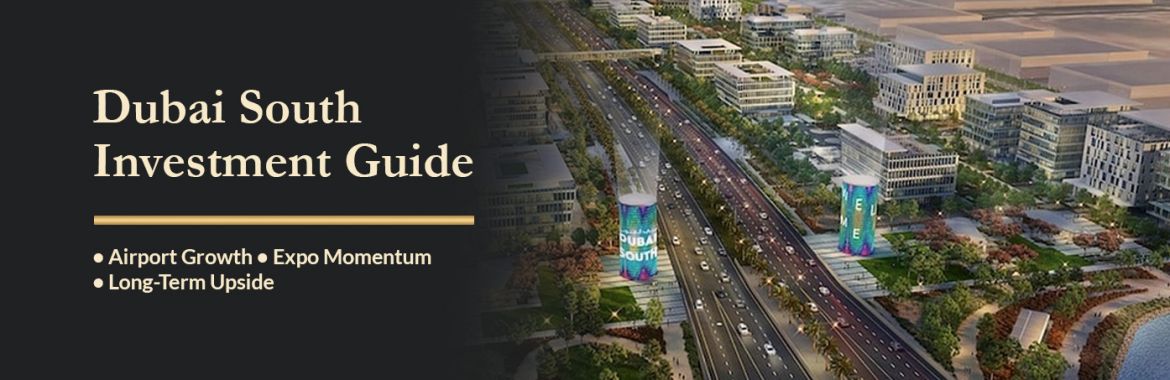
Dubai South Real Estate Investment Guide (2026) for UK Buyers
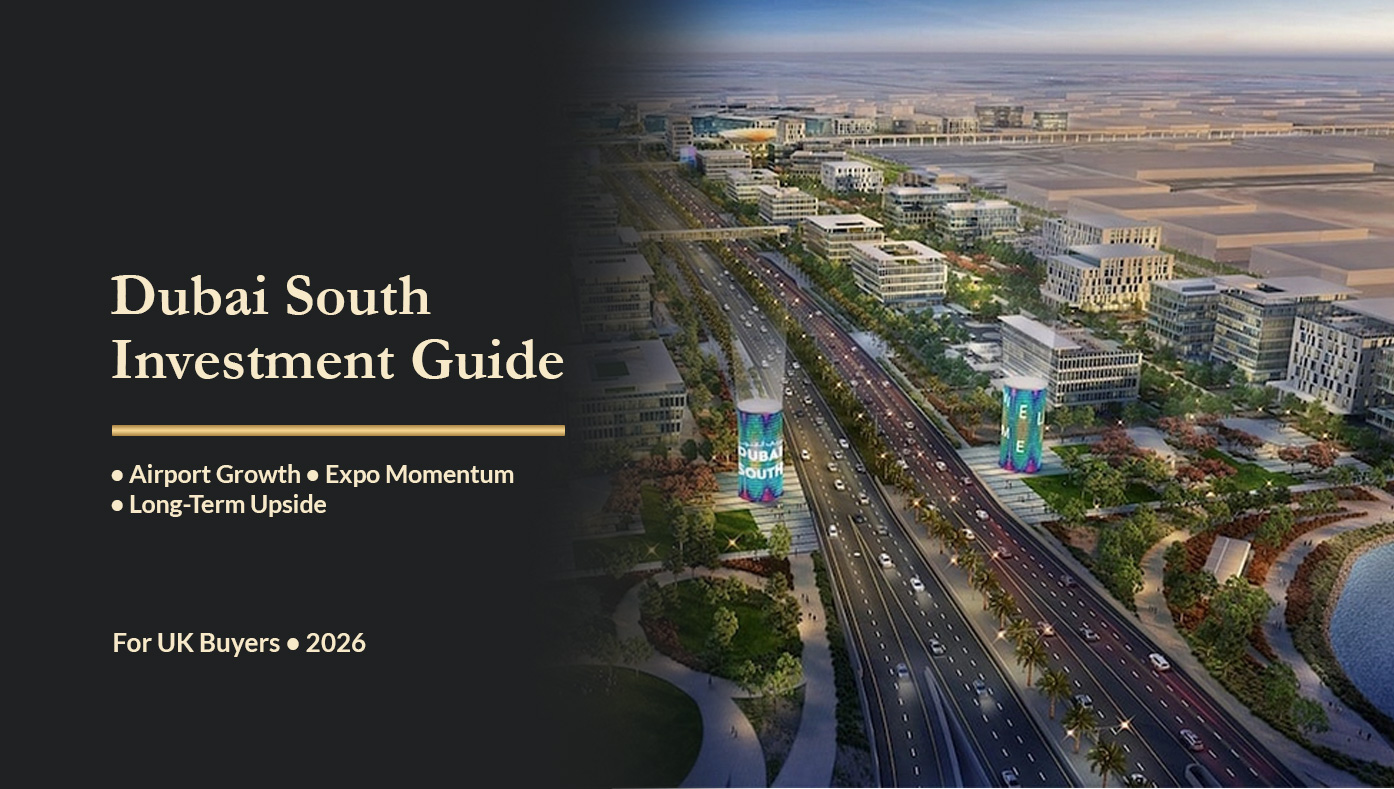
Airport growth, Expo momentum, and long-term upside — Dubai South is no longer a future story only. It is becoming a present-day investment conversation for serious UK buyers.
Some areas in Dubai attract attention because they are already famous. Others attract attention because smart investors can see where the city is heading before the wider market fully prices it in. Dubai South real estate sits firmly in that second category.
For buyers in London, Manchester, Birmingham, Glasgow, and across the UK, Dubai South has become harder to ignore for one simple reason: it connects long-term infrastructure, practical housing demand, and growth-led positioning in a way that feels much bigger than a single neighbourhood story. It is not just another residential district. It is part of a wider urban, logistics, aviation, and business corridor that continues to shape how global investors think about the southern side of Dubai.
That does not mean every property in Dubai South is automatically a strong purchase. It is not a shortcut market. It still requires care, building-level selection, and a clear understanding of why you are buying. But for the buyer who wants more than a polished brochure and is willing to think a few steps ahead, Dubai South property investment can make a great deal of sense.
If your goal is to invest in Dubai from London or from anywhere in the UK with a more strategic eye, this is exactly the type of district worth studying properly. Not because it is the loudest location in the market, but because it is tied to some of Dubai’s most important long-range development drivers.
Why Dubai South matters so much in 2026
The real attraction of Dubai South real estate is not just what the area is today. It is what it is connected to.
You are looking at a district shaped by Al Maktoum International Airport, the broader aviation ecosystem, logistics activity, business expansion, Expo City influence, and a growing residential base that appeals to both investors and end users. That combination gives Dubai South a very different feel from communities that rely mainly on lifestyle branding or short-term investor enthusiasm.
For UK investors, that matters. Overseas buyers usually do better when they buy into a bigger urban story rather than a one-dimensional sales pitch. When a community is connected to transport, employment, logistics, and long-term city planning, the investment case tends to feel more durable. That is one of the main reasons Dubai South continues to stay on the radar of buyers who are not only chasing quick flips but also thinking about rental demand, future growth, and market relevance over time.
This is also why the area sits naturally beside wider research on working with a Dubai-based real estate agency that understands London and UK investors. A district like this needs proper interpretation. It is not enough to know that the area is “growing.” You need to understand what kind of growth matters, what kind of stock fits that growth, and where the smarter entry points may actually be.
What makes Dubai South property different from many other Dubai communities?
One of the biggest differences is that Dubai South is not built around one single lifestyle identity. It is broader than that. It combines residential districts, business zones, logistics activity, aviation relevance, and nearby destination power from Expo City and surrounding developments.
That gives it a different investment profile from areas like JVC, which are often more apartment-led and tenant-density driven, or Business Bay, which is far more central, vertical, and city-core focused. Dubai South feels more like a corridor of future relevance than a single urban pocket.
For buyers who prefer districts with room to evolve, that can be a major advantage. The area appeals to people who like the idea of entering a market with visible long-term catalysts rather than paying a premium for an already fully established address. In plain terms, it suits investors who are comfortable buying growth with logic behind it.
How important is the airport story to Dubai South investment?
It is extremely important, but it should be understood properly.
A lot of articles reduce Dubai South to one line about the airport and stop there. That is too simplistic. The stronger point is not just that an airport exists nearby. The stronger point is that the scale of long-term aviation planning around Al Maktoum International Airport feeds into a much larger economic and infrastructure narrative for the district.
Markets tend to take infrastructure seriously when it changes how an area will be used, connected, and valued over time. That is exactly why Dubai South real estate investment keeps gaining attention. The airport factor is not just about flights. It is about logistics, commercial activity, workforce movement, investor confidence, and the credibility of the wider master-planned story.
For a British buyer, this matters because it turns the area from a speculative location into a strategic one. Not risk-free, of course, but much easier to justify from a long-term portfolio perspective.
Why does Expo City strengthen the Dubai South story?
Expo City Dubai gives the wider corridor a more future-facing identity. It adds another layer to the investment narrative beyond aviation and logistics. That matters because strong real estate districts rarely depend on only one economic pillar. The most resilient locations usually benefit from multiple engines at once.
Expo City helps bring that wider ecosystem into view. It adds innovation, sustainability, business activity, events, residential credibility, and long-term placemaking value to the southern side of the city. That gives Dubai South property something many growth locations struggle with: a clearer sense of long-range purpose.
For investors, that matters more than it first appears. Residential demand strengthens when an area is not just technically connected, but also culturally, commercially, and strategically relevant. The more layers a district has, the easier it becomes to defend the investment case over time.
That is especially useful for buyers who are not only seeking rent, but also looking for a district that feels likely to mature into something much more valuable over the next cycle.
What kind of buyer is Dubai South best suited to?
Dubai South property investment is usually best suited to the buyer who is comfortable thinking ahead. It appeals strongly to people who want growth potential, newer stock, more space for budget, and a community tied to infrastructure-led expansion rather than prestige alone.
It can work especially well for four types of buyers. The first is the investor who wants to enter Dubai at a more practical price point than the city’s prime districts. The second is the portfolio builder who wants at least one asset linked to a long-term infrastructure corridor. The third is the buyer who values newer communities and master-planned environments. The fourth is the family-minded investor who may want future personal use, not just rental income.
That is why Dubai South often attracts a different buyer profile from the one searching for immediate city-centre energy or waterfront prestige. It tends to appeal to people who are looking for positioning, not just branding.
What do Dubai South property prices feel like in 2026?
In broad terms, Dubai South property prices still feel more approachable than many of Dubai’s headline districts, especially when buyers compare what they are getting in terms of space, project freshness, and future-area story.
That does not mean everything is cheap. It also does not mean the area should be treated as a bargain-bin market. The better way to think about it is value relative to long-term context. For many UK buyers, that is exactly the right lens.
When pricing remains lower than prime central districts but the surrounding development story remains strong, the area becomes naturally attractive to buyers who want room for upside without needing to overextend. That is one of the strongest reasons Dubai South real estate keeps pulling in attention from British investors who want something more strategic than fashionable.
If you are still early in your search, it also helps to place Dubai South alongside broader guides such as how the buying process works from London and the wider UK, because entry price only makes sense when the legal, financial, and practical side of the purchase is understood properly too.
Is Dubai South mainly a growth play, or can it work for rental income too?
The best answer is that Dubai South can work for both, but the exact investment logic depends heavily on the type of unit, the subcommunity, and the buyer’s time horizon.
Some investors come to Dubai South because they see long-term growth tied to the airport, Expo City influence, and continued expansion in the broader corridor. Others come because they see an opportunity to buy into newer residential stock at more manageable pricing while still targeting a tenant base that values affordability, freshness, and location logic.
That balance is one of the area’s strengths. It is not only a future-value district, and it is not only an income district. It sits in between. For many UK investors in Dubai real estate, that is exactly the kind of blend that makes a market worth considering seriously.
The key, however, is not to assume every asset will behave the same way. Apartment-led income strategies, townhouse-led family strategies, and longer-hold growth strategies can all work here, but they should not be judged by the same criteria.
Which parts of Dubai South should buyers pay closer attention to?
This is where things become more nuanced. Dubai South is not one single product. It includes different residential pockets and project types, and some will naturally suit UK buyers better than others.
For many investors, apartment-led projects remain the easiest starting point because they offer lower entry, broader tenant potential, and simpler portfolio building. For others, townhouse and villa communities can be more compelling where lifestyle, family appeal, or longer-hold end-user positioning matters more.
Submarkets connected to the wider Emaar South conversation are also worth watching for buyers who like a greener, more master-planned, golf-linked lifestyle angle. That is why projects tied to the southern growth belt often sit naturally beside UK buyer interest in Dubai’s newer green-living communities and other well-positioned developments in the same broader corridor.
The smartest approach is usually not to start with a project. It is to start with your objective. Income, capital growth, future use, or a blended strategy. Once that is clear, the right part of Dubai South becomes much easier to identify.
What are the biggest strengths of Dubai South real estate investment?
The first major strength is strategic relevance. Dubai South is tied to more than residential marketing. It sits within a long-term urban vision that includes aviation, logistics, business activity, and destination-led development. That gives the district a stronger foundation than areas that depend purely on short-term investor mood.
The second strength is relative value. Many British investors want to enter Dubai without immediately moving into ultra-prime pricing. Dubai South property can offer that opening while still linking the purchase to a large-scale city story.
The third strength is modernity. A lot of stock here feels newer, cleaner, and more aligned with what today’s tenant or future end user actually wants. That can be a meaningful advantage in a market where older inventory in some districts struggles against fresh supply.
The fourth strength is flexibility. The area can work for an income-led purchase, a medium-term growth position, or a more lifestyle-aware family-oriented investment. That range is valuable.
What should UK buyers be careful about?
This is where discipline matters. Dubai South has a compelling story, but a strong story can also make people lazy if they stop asking the right questions.
The biggest mistake is assuming that because the area has major long-term drivers, every building inside it will automatically outperform. That is not how real estate works. You still need to assess developer quality, project positioning, layout practicality, handover credibility, management standards, service charges, and tenant appeal.
The second mistake is buying growth without checking timing. Infrastructure-led districts can be very rewarding, but they can also require patience. Buyers need to be honest with themselves about whether they want immediate cash flow, medium-term performance, or a longer-horizon position linked to wider city expansion.
The third mistake is treating the whole area as interchangeable. It is not. Some projects will feel much more compelling than others. Some unit types will lease more smoothly than others. Some buildings will age better than others. That is exactly why working with a London-facing Dubai property team that understands stock selection properly can make such a huge difference.
Should you choose ready property or off-plan in Dubai South?
Both can work, but they suit different buyer mindsets.
Ready property in Dubai South is often easier for UK buyers who want visibility and realism. You can study the actual building, understand the immediate rental market, compare like-for-like units, and make a more grounded decision based on what already exists.
Off-plan property in Dubai South can be very attractive when the developer is credible, the payment plan is workable, and the project sits in the right part of the market cycle. This is especially true for buyers who want to position themselves early in a growth corridor rather than buying only when everything is already mature and fully priced.
That is also where the area naturally overlaps with wider UK buyer research around higher-potential Dubai projects being shortlisted from the UK. The important thing is to stay selective. Not every new launch is a strong opportunity just because it is in a growth district.
How does Dubai South compare with other communities UK investors often consider?
Compared with JVC, Dubai South usually feels more corridor-led and future-infrastructure focused. JVC is often easier to read as a mature apartment-rental district, while Dubai South often appeals more to buyers who want to connect their purchase to long-term development and newer master planning.
Compared with Business Bay, Dubai South is far less central and far less city-core in character. Business Bay works well for investors who want immediate urban intensity. Dubai South works better for those who want space, newer environments, and a bigger long-range story.
Compared with Dubai Marina or Downtown-style buying, Dubai South property investment is generally less about prestige and more about positioning.
That is why the right answer is rarely that one area is universally better than another. The real question is which area fits your goals, budget, and time horizon more intelligently.
So, is Dubai South a good place to invest in Dubai from the UK?
For many buyers, yes.
If you want a district shaped by major infrastructure, supported by a wider business and logistics ecosystem, strengthened by Expo momentum, and still offering more approachable entry than many prime parts of Dubai, then Dubai South real estate deserves a serious place on your shortlist.
It is especially attractive for the buyer who wants to think beyond today’s noise and position capital around where Dubai is expanding, not only where it has already peaked in visibility. That mindset usually suits disciplined UK investors very well.
But the strongest version of this strategy is not simply “buy in Dubai South.” It is to buy the right asset in Dubai South, at the right stage, for the right reason. That means being clear about whether you are prioritising income, future growth, family use, or a more balanced hold. Once that is clear, the area can become a very compelling part of a Dubai portfolio.
For buyers who want a secure, forward-looking route into Dubai real estate investment, Dubai South is not just worth watching. It is worth understanding properly before more of the market catches up to what is already happening there.
Why Work With Aeon & Trisl UK?
Aeon & Trisl UK helps British buyers read Dubai South properly — not just as a trend, but as a long-term investment corridor. From shortlisting the right subcommunities and developers to comparing ready and off-plan opportunities, the focus is on clearer strategy, stronger due diligence, and smarter entry points for UK investors buying in Dubai.
If you are exploring Dubai South property from the UK, speak with Aeon & Trisl UK for a clearer strategy on the right communities, the right projects, and the right long-term investment path.